

In a Georgia parking lot accident, the party who pays depends on what caused the injury. A negligent driver may be responsible through automobile liability insurance. A property owner, occupier, parking operator, employer, or maintenance contractor may also be responsible when unsafe property conditions or work-related conduct contribute to the accident.
Georgia law can divide fault among several parties. Identifying everyone who contributed to the accident can affect which claims, insurance policies, and sources of compensation may apply.
Princenthal, May & Wilson LLC represents people injured in parking lots and other accident settings throughout Georgia. The key question is not simply where the accident happened. The key questions are who had a duty to act carefully, what that person or business did or failed to do, and whether that conduct caused the injury and resulting losses.



Why Parking Lot Injury Claims Can Be Complicated 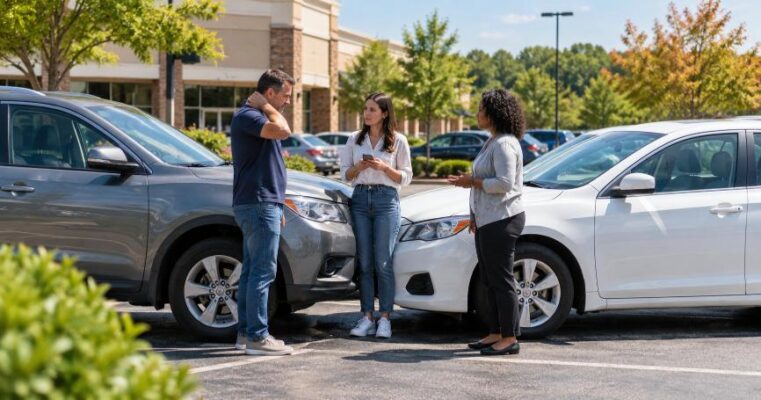
Parking lots bring moving vehicles, pedestrians, shopping carts, delivery vehicles, bicycles, and people entering or leaving stores into a relatively small space. A low-speed collision can still cause a serious injury. A fall may appear to be a simple premises accident until evidence shows that broken pavement, poor lighting, a damaged wheel stop, standing water, or another property condition contributed to it.
Determining who may be responsible often requires looking beyond the location of the accident and identifying the conduct or property condition that caused the injury.
More than one party may be responsible for the same parking lot injury. Identifying every contributing party can affect the insurance coverage and compensation available.
When a Negligent Driver May Be Responsible
Drivers should expect pedestrians to walk between parked vehicles, vehicles to back out of spaces, and traffic patterns to change near entrances and exits.
A driver may be responsible when evidence shows conduct such as:
- Backing without checking mirrors, blind spots, or the area behind the vehicle
• Driving too fast for the level of vehicle or pedestrian activity
• Looking at a phone instead of watching the travel lane
• Cutting across parking spaces without checking for traffic
• Failing to yield while turning through a pedestrian route
• Striking a person while entering or leaving a parking space
If driver negligence caused the injury, the at-fault driver’s liability insurance may be a primary source of compensation.
Learn more about Georgia car accident claims:
https://www.princemay.com/georgia-car-accident-lawyers/
Attorney At Law Attorney At Law Attorney At Law
Adam Princenthal

David May

Matthew Wilson
When a Property Owner or Occupier May Be Responsible
Some parking lot accidents are caused by unsafe property conditions rather than careless driving. In other cases, both a driver and a property condition may contribute to the injury.
Under O.C.G.A. § 51-3-1, an owner or occupier who invites people onto property for a lawful purpose must exercise ordinary care in keeping the premises and approaches safe.
Potential hazards can include:
- Potholes
• Broken pavement
• Damaged wheel stops
• Poor lighting
• Unsafe curbs
• Hidden elevation changes
• Standing water
• Debris
• Sight obstructions near pedestrian routes
Property ownership alone does not automatically establish liability. A claim may depend on who controlled the area, who was responsible for inspection and maintenance, whether the dangerous condition was known or should have been discovered, and whether the injured person knew about the hazard.
Parking lot responsibilities may be divided among property owners, tenants, property managers, parking operators, and contractors. Contracts, inspection records, maintenance logs, photographs, surveillance footage, and prior complaints may help identify who controlled the condition.
Learn more about Georgia premises liability claims:
https://www.princemay.com/georgia-premises-liability-lawyers/
After a car accident, I contacted David May at the Lagrange office. He, and his staff, helped me with medical advice and follow up doctors visits, along with dealing with my insurance and the insurance of the woman that hit me. I have been very pleased with the service I received from David May and the Lagrange staff. They are warm and open, always there to help with advice and answer questions.” - Debau I highly recommend Adam Princenthal .I was looking for someone with years of experience in personal injury.They needed to be knowledgeable, transparent and honest.I wanted to know I was dealing directly with the lawyer I hired.Adam Princenthal could answer all the difficult questions and phone calls were returned.Adam got the settlement I was looking for in a timely manner." - Nancy K. I am glad that I was referred to Princenthal & May. Matthew met with me and gained my trust with the case. I was never left in the dark on any matters, My phone calls were either answered or returned quickly. The office staff are very friendly as well. My case was settled, with both Matthew and Adam present. Both are very professional in their work.. They work for you !!!" - Jacque Minor
Who Pays When a Pedestrian Is Hit?
Pedestrian injuries in parking lots often raise questions about visibility, vehicle speed, driver attention, right of way, and the pedestrian’s path.
Surveillance video can be especially useful because it may show when the pedestrian became visible, whether the vehicle stopped before moving, and how the impact occurred.
A property condition may also contribute. For example, a driver in a Sandy Springs, Georgia, retail parking lot may fail to see a pedestrian because the driver is distracted while landscaping, signage, parked vehicles, or another obstruction limits the sightline. When several conditions contribute to the same injury, more than one party may need to be investigated.
Learn more about Georgia pedestrian accident claims:
https://www.princemay.com/georgia-pedestrian-accident-attorneys/
Can an Employer, Contractor, or Parking Operator Be Responsible?
Yes, depending on the facts.
An employer may be responsible when an employee causes a collision while acting within the scope of employment. A valet company may be involved when careless vehicle handling causes an injury. A maintenance contractor may be relevant when defective repair work, failed lighting, or an unsafe surface contributes to the accident.
A parking management company may also have contractual duties involving traffic flow, maintenance, security, or inspections. The company responsible for a dangerous condition may not be obvious from the scene. Contracts, property records, maintenance agreements, and incident records may help identify the responsible parties.
What If the At-Fault Driver Has Little or No Insurance?
The injured person’s own automobile insurance policy may become relevant when the at-fault driver is uninsured or does not have enough coverage.
Uninsured or underinsured motorist coverage may provide another potential source of compensation, depending on the policy and circumstances.
Medical payments coverage, if purchased, may also help pay certain medical expenses regardless of fault, subject to the policy terms.
You should not assume that the first insurance policy identified is the only coverage that may apply. A parking lot injury involving a vehicle, business, property owner, employer, or contractor may involve several policies.
Hiring a Personal Injury Attorney How Long Will a Personal Injury Case Take?Related Videos
How Georgia Comparative Fault Can Affect a Parking Lot Claim
Georgia uses a modified comparative fault system under O.C.G.A. § 51-12-33.
If an injured person is partly responsible for an accident, compensation may be reduced by that person’s percentage of fault. If the injured person is found 50 percent or more responsible, recovery is generally barred.
Parking lot cases often produce shared-fault arguments. Examples include:
- One driver claims that both vehicles were moving before the collision
• A property owner argues that a pothole or surface defect was visible
• An insurer contends that a pedestrian entered a travel lane without enough caution
• Multiple businesses dispute who controlled or maintained the area where the accident happened
Objective evidence can be especially useful when witnesses remember an accident differently.
Learn more about Georgia personal injury claims:
https://www.princemay.com/georgia-personal-injury-lawyers/
What Evidence Can Help Show Who Should Pay?
Parking lot evidence can disappear quickly. Surveillance systems may overwrite video, vehicles can be repaired, pavement defects may be patched, and witnesses can become harder to locate.
Useful evidence may include:
- Photographs and video of the accident scene
• Vehicle positions and damage
• Signs and lane markings
• Curbs, potholes, wheel stops, pavement defects, and lighting conditions
• Witness names and contact information
• Store, apartment, hospital, or business surveillance footage
• Dashcam footage
• Incident reports
• Police reports
• Medical records and bills
• Wage records showing missed work
• Repair estimates
• Maintenance and inspection records
• Prior complaints about the same condition
• Contracts identifying who managed or maintained the parking area
• Insurance information for drivers, businesses, property owners, or parking operators
If a vehicle collision is involved, review the firm’s guide on what to do after a car accident:
https://www.princemay.com/what-to-do-after-a-car-accident/
What Compensation May Be Available?
A successful Georgia parking lot injury claim may seek compensation for losses caused by the accident.
Depending on the facts, recoverable losses may include:
- Past medical expenses
• Future medical expenses
• Lost income
• Reduced earning capacity
• Pain and suffering
• Property damage
The value of a claim depends on the evidence, the severity and duration of the injuries, available insurance coverage, disputed fault, and other case-specific facts. No lawyer can promise a particular settlement or verdict.
Insurance companies may dispute whether treatment was necessary, whether the accident caused the claimed injury, or whether a pre-existing condition explains some symptoms. Medical records, diagnostic findings, treatment records, and consistent documentation can help show the connection between the accident and the claimed losses.
How Long Do You Have to File a Georgia Parking Lot Injury Claim?
Under O.C.G.A. § 9-3-33, many Georgia personal injury claims are generally subject to a two-year filing period.
Exceptions can change the deadline. Claims involving government property or government employees may also involve separate notice requirements that can arise sooner.
The filing deadline is not the only reason to act promptly. Surveillance footage can be deleted, witnesses can become difficult to locate, vehicles can be repaired, and a dangerous property condition may be changed before it is documented.
What Should You Do After a Parking Lot Accident?
Focus first on safety and medical needs. Call for emergency assistance when someone may be seriously injured.
When circumstances allow:
- Report the incident to the business, property manager, or parking operator
• Photograph the area from several angles before vehicles or surrounding conditions change
• Photograph vehicle damage and visible injuries
• Identify nearby surveillance cameras
• Get witness names and contact information
• Exchange driver and insurance information when a vehicle is involved
• Avoid guessing about fault at the scene
• Seek medical evaluation when symptoms develop
• Keep medical bills, wage records, repair estimates, insurance letters, photographs, and other records
• Avoid signing a release until you understand which claims and future costs it may cover
Speak With a Georgia Attorney About a Parking Lot Injury
A parking lot accident can involve automobile insurance, premises liability coverage, business insurance, employment issues, property maintenance responsibilities, and competing accounts of what happened.
Princenthal, May & Wilson LLC can review the circumstances, identify potentially responsible parties, preserve available evidence, and explain the legal options that may apply.
The firm offers free consultations and represents injured people throughout Georgia, including Sandy Springs, LaGrange, and nearby areas.
Sandy Springs office:
678-534-3749
LaGrange office:
706-810-5221
Contact Princenthal, May & Wilson LLC:
https://www.princemay.com/contact-us/
This article is for informational purposes only and is not legal advice. Consult an attorney about your specific situation.