
Liability for a crash in a Georgia school zone depends on who caused the danger, not simply on where the collision happened. A speeding or distracted driver may be responsible, but a school bus operator, employer, transportation contractor, vehicle owner, another driver, or public entity may also share fault when the facts support liability.
If you or your child was injured, the investigation should identify what each person or entity did before the crash, what traffic controls were active, what insurance applies, and whether a shorter notice deadline may affect the claim. School-zone cases often require prompt evidence preservation because camera footage can be overwritten, vehicles can be repaired, and witness memories can fade.
Princenthal, May & Wilson LLC represents injured people and families throughout Georgia, including Sandy Springs, LaGrange, and nearby areas.

Why School Zone Crashes Can Be More Complicated 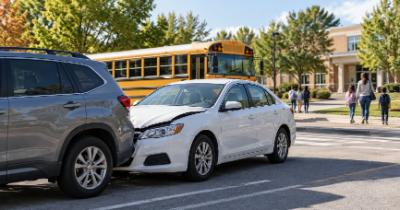
School-zone crashes can involve children, parents, teen drivers, buses, crossing guards, bicyclists, delivery vehicles, and commuters moving through the same limited area. A collision may happen at a crosswalk, in a pickup lane, at a school entrance, near a bus stop, or on the roadway passing the school.
The main liability question is usually whether someone failed to use reasonable care. Georgia drivers must obey applicable traffic controls and drive with reasonable care for surrounding conditions. A driver can be negligent even without receiving a speeding ticket if distraction, unsafe following distance, an improper turn, failure to yield, or another unsafe act caused the crash.
For a broader explanation of Georgia collision claims, see:
https://www.princemay.com/georgia-car-accident-lawyers/
A School Zone Does Not Automatically Decide Fault
School-zone location alone does not determine liability. The evidence must show who created or contributed to the danger.
The location of the crash matters, but the school zone itself does not automatically make one party liable. Evidence must connect a driver, company, property owner, contractor, or public entity to the conduct or condition that caused the injury.
The Negligent Driver Is Often the Primary Liable Party
A driver may be liable when careless driving causes an injury in a school zone. Common examples include:
- Driving faster than the posted school-zone limit when that limit is in effect
• Looking at a phone, navigation screen, or another distraction
• Following another vehicle too closely in arrival or dismissal traffic
• Turning across a crosswalk without checking for pedestrians
• Passing a vehicle that has stopped for a pedestrian
• Failing to stop for a school bus when Georgia law requires a stop
• Backing from a parking or pickup space without checking behind the vehicle
• Driving too fast for congestion, visibility, traffic, or other conditions
Georgia law requires drivers to stop and remain stopped for certain pedestrians in crosswalks under O.C.G.A. § 40-6-91. Georgia law also requires drivers, subject to statutory exceptions, to stop for a school bus displaying the required visual signals under O.C.G.A. § 40-6-163.
A traffic violation may support a civil injury claim, but a citation does not automatically resolve every issue of negligence, causation, comparative fault, or damages.
When a child or another pedestrian is struck, this page explains related pedestrian accident issues:
https://www.princemay.com/georgia-pedestrian-accident-attorneys/
Attorney At Law Attorney At Law Attorney At Law
Adam Princenthal

David May

Matthew Wilson
Can More Than One Driver Share Fault?
Yes. School-zone traffic can involve sudden stops, short gaps, turning vehicles, and several drivers entering or leaving the same roadway. One driver may be speeding while another makes an unsafe turn. A vehicle may stop unexpectedly while a following driver leaves too little distance to react safely.
Georgia uses a modified comparative fault system under O.C.G.A. § 51-12-33. If you are assigned part of the fault for your injury, your recoverable damages may be reduced by your percentage of fault. If you are 50 percent or more responsible, you generally cannot recover damages under that rule.
This makes photographs, video, witness statements, vehicle data, traffic-control records, and other evidence especially valuable when the people involved give conflicting accounts of the crash.
When an Employer or Vehicle Owner May Be Responsible
A school-zone crash may involve legal responsibility beyond the person behind the wheel. If a driver was acting within the scope of employment when the collision happened, the employer may be responsible for the employee’s negligence under Georgia law.
A vehicle owner may also require investigation when the facts support negligent entrustment or another recognized basis for liability. Ownership by itself does not make every owner responsible for every crash. The relationship among the driver, owner, employer, vehicle, and purpose of the trip must be examined.
For example, consider a delivery driver entering a school pickup area in Sandy Springs while checking dispatch information. If the driver strikes another vehicle or a pedestrian, the investigation may address the driver’s conduct, the purpose of the trip, the employer’s relationship to the driver, and any available commercial insurance.
After a car accident, I contacted David May at the Lagrange office. He, and his staff, helped me with medical advice and follow up doctors visits, along with dealing with my insurance and the insurance of the woman that hit me. I have been very pleased with the service I received from David May and the Lagrange staff. They are warm and open, always there to help with advice and answer questions.” - Debau I highly recommend Adam Princenthal .I was looking for someone with years of experience in personal injury.They needed to be knowledgeable, transparent and honest.I wanted to know I was dealing directly with the lawyer I hired.Adam Princenthal could answer all the difficult questions and phone calls were returned.Adam got the settlement I was looking for in a timely manner." - Nancy K. I am glad that I was referred to Princenthal & May. Matthew met with me and gained my trust with the case. I was never left in the dark on any matters, My phone calls were either answered or returned quickly. The office staff are very friendly as well. My case was settled, with both Matthew and Adam present. Both are very professional in their work.. They work for you !!!" - Jacque Minor
What If a School Bus Is Involved?
A school bus crash can raise separate liability questions involving the bus driver, a private transportation company, a maintenance provider, or a public school system. The correct parties depend on who operated the bus, who employed the driver, who maintained the vehicle, and what conduct caused the injury.
A bus driver may be negligent because of unsafe lane movement, distracted driving, an improper stop, failure to yield, or another driving error. A private transportation contractor may face responsibility for its own negligence or, in some cases, for an employee’s negligence within the scope of employment.
Claims involving a public school system or another government body require careful review. Sovereign or governmental immunity, available insurance waivers, ante litem notice rules, and other statutory requirements can affect whether a claim may proceed. Some government-related claims require notice on a deadline that is much shorter than the general personal injury filing period.
A crash near a public school does not by itself make the school system responsible.
Hiring a Personal Injury Attorney How Long Will a Personal Injury Case Take?Related Videos
Could a City, County, or Roadway Agency Be Liable?
A roadway condition may become part of the liability analysis when the evidence connects that condition to the crash. Potential issues can include a malfunctioning traffic signal, a missing or obscured sign, a dangerous sight obstruction, or another roadway condition that a responsible public entity had a legal duty to address.
Government defendants can have legal protections and procedural requirements that do not apply to private drivers or businesses. If roadway maintenance, traffic controls, a government vehicle, or another public function may have contributed to the collision, prompt legal review can help identify the correct entity and any notice requirement that may apply.
What Evidence Helps Prove School Zone Crash Liability?
School zones may have more potential evidence sources than an ordinary roadway. Useful evidence can include:
- Police crash reports
• Photographs and videos from the scene
• School surveillance footage
• School bus camera footage
• Dash-camera footage
• Video from nearby homes or businesses
• Crossing guard statements
• Witness statements
• Vehicle event data
• Phone records when distraction is disputed
• School arrival and dismissal schedules
• Records showing when flashing lights or other traffic controls were active
• Bus route records
• Driver qualification or training records when relevant
• Vehicle inspection and maintenance records when relevant
• Medical records
• Insurance information
Video systems may overwrite recordings, and physical evidence can change soon after a crash. A preservation request can help protect evidence when responsibility is disputed.
For a practical checklist after a collision, review:
https://www.princemay.com/what-to-do-after-a-car-accident/
What Damages May Be Available After a School Zone Crash?
If another person or entity is legally responsible for your injuries, a Georgia injury claim may seek compensation for losses caused by the crash. Depending on the facts, recoverable damages may include:
- Medical expenses
• Future medical care
• Lost income
• Reduced earning capacity
• Property damage
• Pain and suffering
• Physical limitations
• Other damages allowed under Georgia law
There is no standard settlement value for a school-zone collision. Insurance coverage, comparative fault, the severity and duration of injuries, medical evidence, future needs, and the number of responsible parties can affect the value of a claim.
An insurer may ask you for a recorded statement or send an early release. Before signing a document that could resolve or limit your claim, review:
https://www.princemay.com/speaking-to-an-insurance-adjuster-after-a-car-accident/
How Long Do You Have to File a Georgia School Zone Injury Claim?
Under O.C.G.A. § 9-3-33, Georgia personal injury actions are generally subject to a two-year limitations period. The deadline can vary based on the type of claim, the injured person, the defendant, and other facts.
Claims involving a city, county, school system, state agency, or another government body may involve separate notice requirements that can expire before the general two-year period. Claims involving minors can also raise separate timing rules. Do not assume that a minor’s age automatically extends every deadline, especially when a government entity may be involved.
The safest approach is to investigate the applicable deadlines early. Evidence can disappear long before a lawsuit deadline arrives.
For more information about Georgia negligence, damages, and personal injury claims, visit:
https://www.princemay.com/georgia-personal-injury-lawyers/
How a Georgia School Zone Crash Lawyer Can Help
A Georgia school zone crash lawyer can investigate how the collision happened, identify potentially responsible parties, request available video before it is erased, review insurance coverage, gather medical and wage records, and respond to comparative-fault arguments.
When a bus, business vehicle, private contractor, employer, or public entity is involved, the investigation may also require employment records, maintenance documents, insurance policies, government records, and notices required by law.
Consider a LaGrange afternoon dismissal crash in which one driver rear-ends a stopped vehicle and pushes it into a crosswalk. Liability may depend on following distance, vehicle speed, the pedestrian’s position, traffic-control timing, and whether another driver contributed to the chain reaction. A police report can help document the event, but it may not contain every fact needed to allocate civil responsibility.
Careful case preparation can give you a stronger factual basis for evaluating an insurance offer and deciding whether litigation is appropriate. No attorney can promise a particular result.
Speak With a Georgia School Zone Crash Attorney
If you or your child was injured in a Georgia school-zone crash, Princenthal, May & Wilson LLC can review what happened, identify parties that may be legally responsible, and explain evidence and deadlines that may affect your options.
The firm serves injured people throughout Georgia from offices in Sandy Springs and LaGrange. To discuss your situation, call (678) 534-3749 or visit:
https://www.princemay.com/contact-us/
Phone:
tel:+16785343749
This article is for informational purposes only and is not legal advice. Every case depends on its specific facts and applicable law. Consult an attorney about your situation.