
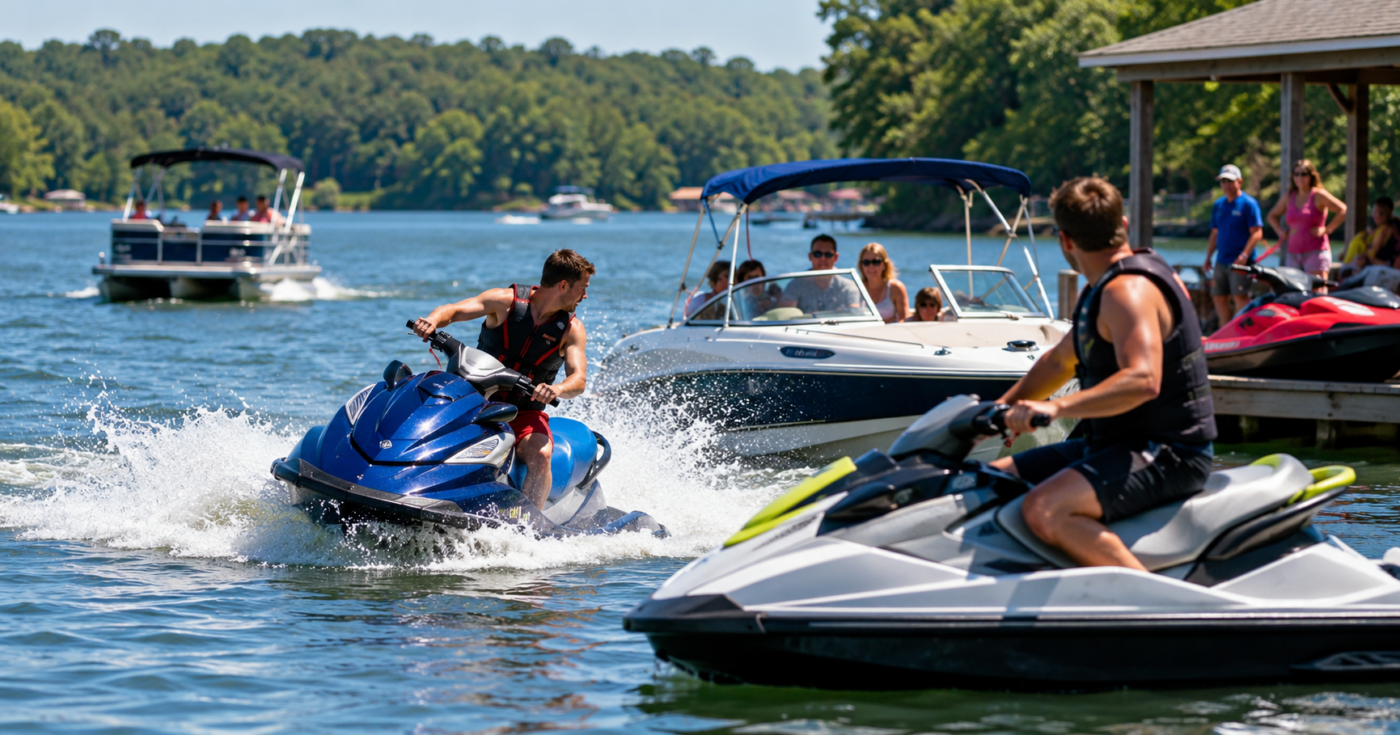
Jet ski and personal watercraft accidents on Georgia lakes are usually liability cases, not simple boating mishaps. Fault may depend on operator speed, life jacket use, rental company conduct, boat traffic, alcohol use, supervision, and whether someone violated Georgia personal watercraft laws. On busy waters such as Lake Lanier, West Point Lake, Allatoona Lake, and Lake Oconee, more than one person or business may share responsibility. Georgia’s comparative fault rules can also reduce or bar compensation if the injured person is found partly responsible.
A personal watercraft can cross open water quickly, turn sharply, and bring riders close to docks, swimmers, boats, and other jet skis. That is part of the appeal. It is also why a Georgia jet ski accident can become serious in seconds.
Personal watercraft crashes often happen without lane markings, traffic lights, or obvious points of impact. The people involved may disagree about who had the right of way, whether a rider was too close to shore, whether a rental operator gave proper instructions, or whether a larger boat created a dangerous wake. Liability is usually determined by piecing together witness statements, photos, damage, rental documents, medical records, safety rules, and the conduct of everyone on the water.
What Makes Jet Ski Accidents Different From Boat Accidents? 
A jet ski is a type of personal watercraft. Georgia law treats personal watercraft as vessels, but they have unique safety risks. Riders sit or stand on the outside surface, which means falls and ejections are common. A rider may also lose steering control when the throttle is released, depending on the watercraft’s design and speed.
Common Georgia personal watercraft accidents include collisions between jet skis, strikes involving boats or docks, passenger ejections, swimmers or tubers being hit, large-wake crashes, rental accidents, and accidents tied to alcohol or reckless operation.
These cases require close attention to boating rules and lake conditions. The legal question is not just who hit whom. It is who failed to act with reasonable care under the conditions.



Georgia Rules That Can Affect Liability
Georgia law defines a personal watercraft to include vessels commonly known as jet skis. It requires each person aboard to wear a properly fastened United States Coast Guard approved personal flotation device. Georgia law also bars operation after sunset or before sunrise, requires certain engine cutoff or self-circling devices, restricts operation above idle speed within 100 feet of docks, moored vessels, people in the water, certain shorelines, public beaches, marinas, and other public use areas, and limits younger riders under age and education rules. Georgia DNR identifies boating laws under O.C.G.A. Title 52, Chapter 7.
When someone violates a safety rule, that violation can become powerful evidence of negligence. A jet ski operator who speeds through a marina area or passes too close to a swimmer may face liability if that conduct causes injury. A parent or adult who knowingly allows an underage child to operate a personal watercraft in violation of Georgia rules may also become part of the liability analysis.
How Fault Is Determined After a Busy-Lake Collision
On crowded lakes, fault is rarely decided by one fact. Attorneys and insurers typically study several layers of evidence.
Operator conduct. Was the jet ski operator speeding, weaving through traffic, following too closely, jumping wakes, ignoring posted restrictions, operating after dark, or riding too close to docks or swimmers?
Lookout and awareness. A safe operator must watch for boats, riders, swimmers, floating debris, docks, and changing lake conditions. Failure to keep a proper lookout is a common liability factor.
Right of way and safe distance. Boat and personal watercraft operators must avoid collisions even when they believe they have the right of way. A rider who cuts across another vessel’s path may be liable.
Alcohol or drug use. Boating under the influence can change the entire case. Evidence may include officer observations, citations, witness reports, video, receipts, or social media posts.
Safety equipment. Missing life jackets, defective lanyards, altered safety devices, and lack of required equipment may support a negligence claim.
Rental company practices. Rental businesses may be examined for age verification, safety briefings, equipment maintenance, warnings, waivers, and whether they rented to someone who appeared impaired or unqualified.
Attorney At Law Attorney At Law Attorney At Law
Adam Princenthal

David May
Matthew Wilson
How Comparative Fault Works in Georgia
Georgia uses a comparative fault system in personal injury cases. If an injured person shares blame, any recovery may be reduced by that person’s percentage of fault. If the injured person is found 50 percent or more at fault, recovery may be barred.
This matters in personal watercraft cases because insurers often argue that the injured person contributed to the crash. They may claim the rider ignored instructions, failed to wear a life jacket properly, rode with an unsafe operator, overloaded the watercraft, or failed to avoid a hazard.
A careful investigation can push back against unfair blame. A passenger may not have known the operator was violating a no-wake zone. A rental customer may have received rushed instructions. A child may have been placed in a situation controlled by adults.
Liability Scenarios on Georgia Lakes
Consider a summer weekend near a busy marina. A personal watercraft rider accelerates through a crowded area and strikes a pontoon boat that is idling near a dock. If the rider was within 100 feet of a dock, marina, or moored vessel while traveling above idle speed, that conduct may support liability. The pontoon operator’s actions still matter, but the jet ski operator’s speed and location would be central facts.
A rental case may look different. If a business gives a first-time rider a key and a brief verbal warning, but no meaningful safety instruction, liability may involve the rider, the rental company, and possibly the owner if maintenance or safety equipment was inadequate.
Another scenario may involve two families riding personal watercraft near West Point Lake or Lake Lanier. One operator jumps a boat’s wake without checking for nearby traffic and lands in the path of another rider. Witnesses, GPS data, photos, damage patterns, and statements from nearby boaters may help show whether reckless wake jumping caused the crash.
After a car accident, I contacted David May at the Lagrange office. He, and his staff, helped me with medical advice and follow up doctors visits, along with dealing with my insurance and the insurance of the woman that hit me. I have been very pleased with the service I received from David May and the Lagrange staff. They are warm and open, always there to help with advice and answer questions.” - Debau I highly recommend Adam Princenthal .I was looking for someone with years of experience in personal injury.They needed to be knowledgeable, transparent and honest.I wanted to know I was dealing directly with the lawyer I hired.Adam Princenthal could answer all the difficult questions and phone calls were returned.Adam got the settlement I was looking for in a timely manner." - Nancy K. I am glad that I was referred to Princenthal & May. Matthew met with me and gained my trust with the case. I was never left in the dark on any matters, My phone calls were either answered or returned quickly. The office staff are very friendly as well. My case was settled, with both Matthew and Adam present. Both are very professional in their work.. They work for you !!!" - Jacque Minor
Evidence That Can Help Prove a Jet Ski Accident Claim
Evidence can disappear quickly after a water accident. Personal watercraft may be repaired, rental records may become harder to obtain, and witnesses may leave before anyone gathers their names.
Helpful evidence may include photos and video, witness names, rental agreements, safety checklists, maintenance records, DNR or law enforcement reports, medical records, life jacket details, insurance information, and any marina or security footage.
People injured in a boating or personal watercraft accident can also review related guidance on Georgia boat accident claims at https://www.princemay.com/georgia-boat-accident-lawyers/. If the accident caused broader injury losses, the Georgia personal injury lawyers page at https://www.princemay.com/georgia-personal-injury-lawyers/ may help explain how injury claims are generally evaluated.
What Compensation May Include
Compensation depends on the facts, available insurance, injury severity, and proof of liability. A claim may include medical bills, future care, rehabilitation, lost income, reduced earning ability, pain and suffering, scarring, emotional distress, and property damage.
Serious personal watercraft injuries can include brain injuries, spinal injuries, fractures, shoulder and knee injuries, deep lacerations, internal injuries, drowning injuries, and long-term pain. Families may also face funeral expenses and wrongful death damages after a fatal lake accident. In those cases, the Georgia wrongful death attorneys page at https://www.princemay.com/georgia-wrongful-death-attorneys/ can provide more context.
Hiring a Personal Injury Attorney How Long Will a Personal Injury Case Take?Related Videos
What To Do After a Jet Ski Accident in Georgia
After any serious watercraft crash, safety comes first. Get medical help, move away from immediate danger when possible, and report the accident to the proper authorities. Do not assume minor pain will stay minor. Adrenaline can hide symptoms after a violent impact or fall.
You should also avoid giving recorded statements to insurers before you understand your rights. Their questions are often designed to assign fault, limit damages, or lock you into incomplete facts before the investigation is finished.
Helpful steps include getting medical care, reporting the accident when required, taking photos, getting witness names, preserving clothing and life jackets, saving rental paperwork, avoiding social media posts, and speaking with a Georgia injury attorney before signing releases.
How an Attorney Helps Determine Liability
A lawyer can help identify all parties who may be responsible, including the jet ski operator, boat operator, personal watercraft owner, rental company, marina, maintenance provider, product manufacturer, or another negligent party. People near the firm’s Sandy Springs office can find location information at https://www.princemay.com/sandy-springs-law-office/. Those closer to west Georgia can find the LaGrange office at https://www.princemay.com/lagrange-law-office/.
An attorney may also send preservation letters, obtain DNR reports, inspect the watercraft, speak with witnesses, analyze rental procedures, consult accident reconstruction specialists, and calculate damages beyond the first round of medical bills. This is useful when an insurer tries to blame the injured person or treat a lake accident as a recreational risk rather than a preventable injury.
Speak With a Georgia Jet Ski Accident Attorney
If you or someone you love was injured in a jet ski or personal watercraft accident in Georgia, Princenthal, May & Wilson LLC can help you understand your options. The firm offers a free consultation and handles personal injury cases across Georgia. Contact the team through https://www.princemay.com/contact-us/ to discuss what happened and what steps may protect your claim.
This article is for informational purposes only and is not legal advice. Consult an attorney about your specific situation.