
August heat can place added stress on tires, especially when they are underinflated, overloaded, worn, damaged, poorly repaired, or affected by a hidden defect. A sudden blowout on I-285 near Sandy Springs, I-85 near LaGrange, or another Georgia highway can cause a driver to lose control and trigger a multi-vehicle crash within seconds.
Liability may involve the driver, vehicle owner, tire shop, manufacturer, trucking company, fleet operator, cargo loader, or more than one party. The answer depends on why the tire failed, what warnings existed, who controlled the vehicle or tire, and whether reasonable inspection, maintenance, repair, loading, or manufacturing practices could have prevented the crash.
Princenthal, May & Wilson LLC helps injured people throughout Georgia investigate tire failures, preserve physical evidence, review maintenance records, identify insurance coverage, and evaluate the legal issues that may affect a claim.



Why August Heat Can Raise Tire Blowout Risk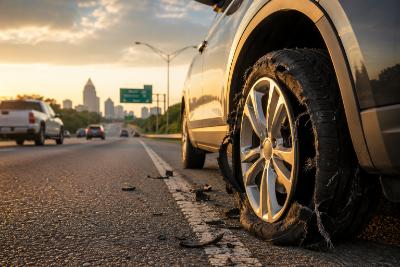
Tires generate heat as they flex against the road. Highway speeds, long trips, heavy cargo, low air pressure, worn tread, and hot outdoor conditions can increase the strain on a tire. The National Highway Traffic Safety Administration states that sustained high temperatures, including long-distance driving in hot weather, can contribute to tire deterioration, blowouts, and tread separation.
NHTSA tire safety guidance is available at https://www.nhtsa.gov/vehicle-safety/tires.
Heat alone does not prove that a tire was defective or that one person caused the crash. Heat may expose an existing weakness or combine with aging rubber, impact damage, improper inflation, overloading, or a poor repair. A careful investigation asks why the tire failed and whether a person or business had a reasonable opportunity to prevent the failure.
Conditions that may contribute to a tire blowout include:
- Low tire pressure
- Excess cargo or uneven weight distribution
- Cracks, bulges, cuts, punctures, or exposed cords
- Uneven or severely worn tread
- Damage from a pothole, curb, or roadway debris
- A tire that does not match the vehicle size or load requirements
- An unsafe patch, mounting job, bead repair, or valve-stem repair
- A recalled tire, internal defect, or tread separation
- Continued driving after vibration, pulling, thumping, or unusual noise
NHTSA advises drivers to check tire pressure when the tires are cold, inspect tread and visible damage, use the tire size recommended by the vehicle manufacturer, and respond to changes in vibration, noise, or handling. A tire pressure monitoring system is not a substitute for regular inspection because many systems warn only after pressure has fallen substantially below the recommended level.
A tire pressure warning, visible bulge, repeated vibration, or damaged tread should be examined before another highway trip.
Attorney At Law Attorney At Law Attorney At Law
Adam Princenthal

David May

Matthew Wilson
How a Tire Blowout Can Cause a Georgia Highway Crash
A rapid loss of pressure can make a vehicle pull sharply, fishtail, leave its lane, strike a barrier, or roll over. A following driver may brake or swerve to avoid the disabled vehicle, scattered tread, or other debris. A commercial truck tire failure can release large tire fragments into several lanes or cause the tractor and trailer to move into nearby traffic.
The legal analysis should account for the failed tire, the driver response, traffic speed, lane position, road conditions, cargo weight, vehicle condition, and any warnings before the collision. A driver who encounters a concealed defect may have little notice. A driver who ignored repeated warnings or visible damage may face a different fault analysis.
Who May Be Liable for a Tire Blowout Crash?
The Driver or Vehicle Owner
A driver or vehicle owner may be responsible when evidence shows that low pressure, visible damage, severe wear, or repeated warnings were ignored. Responsibility may also arise from overloading the vehicle, using the wrong tire, continuing to drive after an impact, or failing to replace a tire that was no longer safe for highway use.
A driver is not automatically at fault because the failed tire was mounted on that person’s vehicle. Some failures begin inside the tire and cannot be found through an ordinary visual inspection. Tire age, pressure records, service invoices, warning lights, photographs, witness statements, and expert findings may help distinguish poor maintenance from a concealed failure.
After a car accident, I contacted David May at the Lagrange office. He, and his staff, helped me with medical advice and follow up doctors visits, along with dealing with my insurance and the insurance of the woman that hit me. I have been very pleased with the service I received from David May and the Lagrange staff. They are warm and open, always there to help with advice and answer questions.” - Debau I highly recommend Adam Princenthal .I was looking for someone with years of experience in personal injury.They needed to be knowledgeable, transparent and honest.I wanted to know I was dealing directly with the lawyer I hired.Adam Princenthal could answer all the difficult questions and phone calls were returned.Adam got the settlement I was looking for in a timely manner." - Nancy K. I am glad that I was referred to Princenthal & May. Matthew met with me and gained my trust with the case. I was never left in the dark on any matters, My phone calls were either answered or returned quickly. The office staff are very friendly as well. My case was settled, with both Matthew and Adam present. Both are very professional in their work.. They work for you !!!" - Jacque Minor
A Tire Shop, Dealer, or Repair Facility
A tire shop, dealer, or repair facility may share responsibility if it installed the wrong tire, damaged the bead, used an unsafe repair method, failed to seat or tighten a wheel correctly, or returned the vehicle to service despite a condition that a careful technician should have identified.
Work orders, invoices, inspection sheets, photographs, technician notes, and prior complaints may show what the business was asked to do, what it inspected, what work it performed, and what warnings it provided.
The Tire or Vehicle Manufacturer
A tire or vehicle manufacturer may face a Georgia product liability claim when a design, manufacturing, or warning defect caused the tire failure and resulting injury. Potential issues may include poor bonding between tire layers, contamination during production, belt separation, unsuitable materials, defective components, or inadequate instructions and warnings.
These claims often require a technical inspection and qualified expert analysis. The tire identification number can help identify the manufacturer, plant, tire size, and production date. Recall information and similar failure reports may also become relevant.
Learn more about Georgia product liability claims at https://www.princemay.com/georgia-product-liability-attorneys/.
Hiring a Personal Injury Attorney How Long Will a Personal Injury Case Take?Related Videos
A Trucking Company, Fleet Operator, or Maintenance Contractor
A trucking company, fleet operator, or maintenance contractor may be responsible for inadequate inspections, deferred maintenance, unsafe loading, poor repair practices, or continued use of damaged tires. A commercial tire failure claim may involve the driver, motor carrier, trailer owner, maintenance company, cargo loader, tire seller, or manufacturer.
The investigation may include driver inspection reports, maintenance files, dispatch records, electronic logging information, vehicle data, cargo documents, tire purchase records, and repair invoices.
Learn more about commercial vehicle claims at https://www.princemay.com/georgia-truck-accident-attorneys/.
Evidence That Can Explain Why the Tire Failed
The failed tire and wheel may be the most valuable physical evidence in the case. They should not be repaired, recycled, returned to a seller, or discarded before qualified investigators have an opportunity to inspect them. Tread fragments recovered from the roadway may help show whether the failure involved impact damage, underinflation, heat damage, tread separation, or another cause.
Preserve the failed tire. It may be the most valuable evidence in your claim.
Useful evidence may include:
- The tire, wheel, valve stem, and recovered tread pieces
- Photographs and video taken before the vehicle is moved
- The tire identification number, size, ratings, and date code
- Tire pressure monitoring information and vehicle event data
- Purchase receipts, alignment records, inspection records, and service invoices
- Tow-yard, repair-shop, storage, and salvage-yard records
- Dash-camera footage, traffic-camera video, and nearby business video
- Witness names, contact details, and statements
- Cargo weights, loading records, and commercial maintenance files
- Recall notices, warranty records, and prior tire complaints
- Medical records, wage records, and proof of other losses
A written preservation request may be necessary when an insurer, towing company, repair shop, fleet owner, seller, or manufacturer controls the evidence. Delay may allow a tire to be discarded, a vehicle to be repaired, or electronic information to be overwritten.
Representative Cases
What to Do After a Tire Blowout Accident
Your safety and medical care come first. Move away from active traffic when it is safe, call 911, and seek medical attention for injuries or concerning symptoms. Some injuries become clearer after the initial stress of the crash has passed.
When circumstances allow:
- Photograph the vehicles, tire debris, wheel, lane markings, barriers, nearby signs, and road conditions.
- Obtain the names and contact information of witnesses.
- Ask where the vehicle, wheel, and failed tire will be stored.
- Tell the towing company, repair shop, and insurer not to discard or alter the tire.
- Keep copies of towing, storage, repair, rental, medical, and wage-loss records.
- Avoid posting crash details, photographs, or injury updates on social media.
- Review any recorded-statement request, release, or broad medical authorization before signing it.
The firm’s car accident guide provides more information about reporting a crash and preserving evidence: https://www.princemay.com/what-to-do-after-a-car-accident/.
Before giving a recorded statement or signing a release, review this guidance: https://www.princemay.com/speaking-to-an-insurance-adjuster-after-a-car-accident/.
How Georgia Fault Rules May Affect Your Claim
Georgia follows a modified comparative fault rule. Your compensation may be reduced according to your assigned share of responsibility. A person found 50 percent or more responsible for the injury or damages generally cannot recover compensation.
In a tire blowout claim, an insurer may argue that you ignored pressure warnings, failed to replace worn tires, overloaded the vehicle, drove too fast for conditions, or reacted improperly. Photographs, maintenance records, vehicle data, witness accounts, and expert analysis may support or challenge those arguments.
Fault can also be divided among several people or businesses. For example, a driver may have missed a warning while a repair shop performed unsafe work and a fleet operator failed to follow its inspection schedule. The evidence should be reviewed before responsibility is assigned.
Deadlines for a Georgia Tire Blowout Claim
Many Georgia personal injury actions are generally subject to a two-year limitation period. Different deadlines may apply based on the defendant, the type of claim, the age of the injured person, government involvement, or other facts. Product liability claims can also involve separate timing rules.
A filing deadline is not the only time concern. Tire evidence may disappear quickly, video may be overwritten, and vehicles may be repaired or sold. Prompt legal review can help identify the applicable deadlines and preserve evidence while it remains available.
Compensation That May Be Available After a Blowout Crash
The compensation available after a tire blowout crash depends on the evidence, Georgia law, insurance coverage, and the losses caused by the collision. A claim may include:
- Emergency care, hospital treatment, doctor visits, therapy, medication, and medical equipment
- Reasonably necessary future medical care
- Lost income and reduced earning ability
- Vehicle damage and other property losses
- Physical pain and limitations
- Emotional effects and loss of normal activities
- Scarring, impairment, or disability when supported by evidence
- Other documented losses caused by the crash
There is no standard settlement amount for every tire blowout case. Similar crashes can lead to different injuries, treatment needs, work losses, insurance disputes, and long-term effects.
How a Georgia Car Accident Attorney Can Help
A Georgia car accident attorney can coordinate the investigation, preserve the tire and vehicle, obtain service and recall records, locate available video, interview witnesses, examine insurance coverage, and consult tire, engineering, reconstruction, trucking, or medical experts when needed.
A lawyer can also identify each potentially responsible party, review requests from insurance companies, document your losses, and respond to efforts to shift blame. Legal representation cannot promise a particular result. It can provide an organized approach to protecting evidence, evaluating fault, and presenting a supported claim.
Learn more about the firm’s collision practice at https://www.princemay.com/georgia-car-accident-lawyers/.
Quick Answers About Georgia Tire Blowout Claims
Can August heat prove that a tire was defective?
No. Heat can contribute to tire deterioration or expose an existing weakness, but the tire, maintenance history, loading, pressure, impact damage, repair history, and manufacturing evidence must be examined.
Who can be responsible for a tire blowout crash?
Potentially responsible parties may include the driver, vehicle owner, tire shop, dealer, manufacturer, trucking company, fleet operator, maintenance contractor, or cargo loader.
Should you keep the failed tire?
Yes. The tire, wheel, valve stem, and tread fragments may help explain the cause of the failure. Do not allow them to be repaired, returned, recycled, or discarded before an inspection.
How long do you have to file a claim?
Many Georgia personal injury cases are generally subject to a two-year limitation period, but exceptions and separate product liability or government-claim deadlines may apply.
Speak With a Georgia Highway Accident Attorney
A tire blowout can leave you managing medical care, missed work, transportation problems, and questions about who caused the failure. Princenthal, May & Wilson LLC offers free consultations and represents injured people throughout Georgia from offices in Sandy Springs and LaGrange. The firm prepares serious injury cases with trial in mind and works to preserve the evidence needed to evaluate fault.
Call the Sandy Springs office at (678) 534-3749 or the LaGrange office at (706) 810-5221.
You can also contact the firm at https://www.princemay.com/contact-us/.
This article is for general informational purposes only. It is not legal advice, does not create a lawyer-client relationship, and may be considered attorney advertising. Speak with an attorney about the facts and deadlines that apply to your situation.