
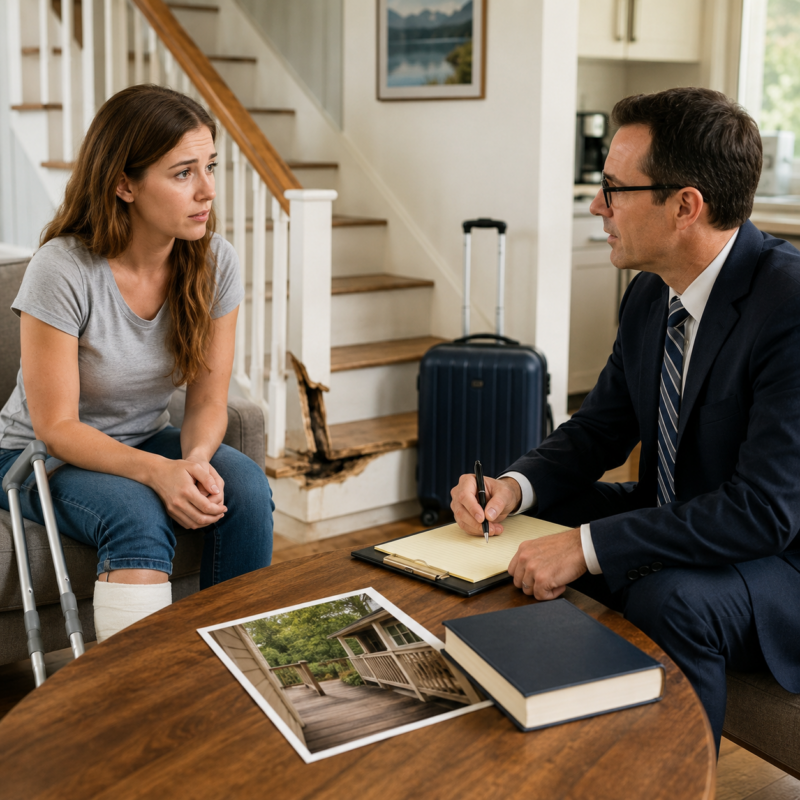
Yes, you may be able to file a claim after suffering an injury at a vacation rental in Georgia. A property owner, host, management company, maintenance contractor, homeowners association, product manufacturer, or another party may be responsible when an unsafe condition causes a guest’s injury.
Georgia premises liability law generally requires owners and occupiers to use ordinary care to keep property and its approaches reasonably safe for invited guests. A successful claim usually depends on who controlled the property, who knew or should have known about the hazard, whether the injured guest knew about the danger, and whether the unsafe condition caused measurable harm.
A Georgia premises liability attorney can investigate the property, preserve evidence, identify insurance coverage, and determine which parties may be legally responsible.


When a Vacation Rental Injury May Support a Claim 
Booking a short-term rental does not mean that you accept every danger on the property. Paying guests are generally invited onto the premises for a lawful purpose. Under O.C.G.A. § 51-3-1, an owner or occupier who invites others onto the property must exercise ordinary care in keeping the premises and approaches safe.
Proof that an injury occurred inside a rental property is not enough by itself. Depending on the facts, an injured guest may need to establish that:
- A dangerous condition existed on the property.
- The owner, occupier, host, or property manager had actual or constructive knowledge of the hazard.
- The responsible party had superior knowledge of the danger.
- The guest lacked knowledge of the hazard despite exercising ordinary care for personal safety.
- The unsafe condition caused the injury.
- The injury resulted in losses, such as medical expenses, lost income, pain, or physical limitations.
Each case depends on its evidence. A loose stair rail reported by prior guests may support a stronger claim than a hazard that appeared moments before an accident and could not reasonably have been discovered.
Attorney At Law Attorney At Law Attorney At Law
Adam Princenthal

David May

Matthew Wilson
Common Hazards at Georgia Vacation Rentals
Vacation rentals may include houses, cabins, condominiums, lake properties, guest suites, and privately managed homes. Some properties do not have employees on site or a documented inspection process.
Common hazards include:
- Broken stairs, loose handrails, or missing guardrails
- Slippery floors, leaking appliances, or poorly maintained walkways
- Unsafe balconies, decks, porches, or rooftop areas
- Defective furniture, ceiling fans, or household equipment
- Inadequate lighting in hallways, driveways, or outdoor steps
- Unsecured swimming pools, hot tubs, or gates
- Electrical problems, exposed wiring, or missing smoke alarms
- Falling tree limbs or poorly maintained outdoor structures
- Dangerous conditions concealed by listing photographs or descriptions
- Security problems involving foreseeable criminal activity
Negligent security claims may involve additional questions about prior criminal activity, foreseeability, security measures, and the property owner’s knowledge. A lawyer must evaluate those issues separately from an ordinary property-defect claim.
A vacation rental injury may fall within Georgia premises liability law even when the accident does not involve a traditional slip and fall. You can learn more on the firm’s Georgia premises liability lawyers page.
After a car accident, I contacted David May at the Lagrange office. He, and his staff, helped me with medical advice and follow up doctors visits, along with dealing with my insurance and the insurance of the woman that hit me. I have been very pleased with the service I received from David May and the Lagrange staff. They are warm and open, always there to help with advice and answer questions.” - Debau I highly recommend Adam Princenthal .I was looking for someone with years of experience in personal injury.They needed to be knowledgeable, transparent and honest.I wanted to know I was dealing directly with the lawyer I hired.Adam Princenthal could answer all the difficult questions and phone calls were returned.Adam got the settlement I was looking for in a timely manner." - Nancy K. I am glad that I was referred to Princenthal & May. Matthew met with me and gained my trust with the case. I was never left in the dark on any matters, My phone calls were either answered or returned quickly. The office staff are very friendly as well. My case was settled, with both Matthew and Adam present. Both are very professional in their work.. They work for you !!!" - Jacque Minor
Who May Be Responsible for the Injury?
Identifying the correct defendant can be one of the hardest parts of a vacation rental claim. The person listed as the host may not own the home, manage repairs, inspect the property, or control guest safety.
Potentially responsible parties may include:
- The property owner
- A host or co-host
- A property management company
- A cleaning service
- A maintenance contractor
- A homeowners association
- The manufacturer or seller of a defective product
Liability often turns on who owned, occupied, managed, maintained, or controlled the area where the injury occurred.
For example, suppose a guest falls through a weakened deck board at a rental home near a Georgia lake. The owner may be responsible if the board deteriorated over time and a reasonable inspection would have revealed the danger. A management company may share responsibility if its agreement required it to inspect and maintain the deck. A contractor may be liable if faulty repair work created or worsened the hazard.
The booking platform may have reporting procedures, contractual terms, and insurance arrangements. Its role depends on the agreement, the incident, and the control it exercised over the property. A lawyer may need to examine the listing agreement, host records, communications, insurance documents, inspection records, and platform policies.
What Evidence Can Strengthen a Vacation Rental Injury Claim?
Evidence at a short-term rental can disappear quickly. The host may repair the hazard after checkout, new guests may arrive, surveillance footage may be deleted, and the online listing may change.
Photograph the unsafe condition before it is repaired, removed, or altered.
An injured guest should preserve as much information as possible, including:
- Photographs and video of the hazard from several angles
- Images showing lighting, warning signs, stairs, flooring, and surrounding conditions
- The original listing, including photographs and property descriptions
- Messages exchanged with the host, owner, or property manager
- Prior guest reviews that mention the same defect
- Names and contact information for witnesses
- Medical records and bills
- Receipts for transportation, replacement lodging, or other accident-related costs
- Employment records showing missed work or reduced earnings
- Clothing or footwear involved in the incident
Report the injury through the booking platform and directly to the host or manager. Keep the report factual. Do not guess about fault, accept blame, or minimize symptoms before receiving a medical evaluation.
Do not delay medical care because you are away from home. Prompt treatment can protect your health and create documentation connecting the injury to the incident. You may also need follow-up treatment after returning home.
Hiring a Personal Injury Attorney How Long Will a Personal Injury Case Take?Related Videos
How Prior Complaints and Reviews May Affect the Case
Knowledge is often disputed in premises liability cases. A host may claim that no one reported the problem. Prior reviews, maintenance requests, inspection records, repair invoices, photographs, or messages from earlier guests may show otherwise.
Consider a rental with a stairway that shifts under pressure. If several guests complained about the stairs and the host continued accepting reservations without arranging repairs, those complaints may help establish actual notice. Photographs showing long-term water damage, rotted wood, repeated patchwork repairs, or another condition that developed over time may support an argument that the hazard should have been discovered.
Constructive knowledge may apply when a reasonable inspection would have revealed the danger, even if the owner denies receiving a direct complaint. The investigation may examine how often the property was inspected, who performed the inspections, whether cleaners reported defects, and whether recommended repairs were delayed.
Can the Guest Be Blamed for the Accident?
Georgia follows a modified comparative negligence system. Compensation may be reduced when the injured person shares responsibility. A person who is found 50 percent or more responsible generally cannot recover damages.
An insurer may argue that the danger was open and obvious, that the guest ignored a warning, or that alcohol, distraction, footwear, or poor judgment contributed to the accident. These arguments do not automatically defeat a claim. Photographs, witness statements, lighting conditions, property layout, warnings, and the guest’s reason for encountering the condition may affect the analysis.
Avoid giving a recorded statement to an insurance company before understanding who the adjuster represents, why the statement is requested, and how it may be used. The firm’s Georgia personal injury lawyers page explains how legal counsel can investigate negligence and address insurance-company arguments.
What Compensation May Be Available?
A successful vacation rental injury claim may include compensation for financial and personal losses, including:
- Emergency treatment, hospitalization, surgery, and rehabilitation
- Future medical care related to the injury
- Lost wages and reduced earning capacity
- Pain, physical limitations, and emotional distress
- Travel or lodging expenses caused by the accident
- Permanent scarring, disability, or loss of normal activities
The value of a claim depends on the severity of the injury, the strength of the liability evidence, available insurance coverage, and the long-term effect on the injured person’s life. No attorney can promise a specific result.
How Long Do You Have to File a Claim?
Georgia personal injury lawsuits are generally subject to a two-year statute of limitations under O.C.G.A. § 9-3-33. Exceptions may change the deadline, and contractual or insurance notice requirements may apply much sooner.
Waiting can weaken the evidence. Repairs may erase the unsafe condition, electronic messages may be lost, and witnesses may become difficult to locate. Early legal guidance can help preserve the listing, request inspection records, identify insurance coverage, and send evidence-preservation notices.
What a Georgia Premises Liability Lawyer Can Do
A lawyer can determine who owned and controlled the rental, inspect the property, obtain booking records, review prior complaints, identify available insurance, and consult qualified experts when needed. Counsel can also document losses, communicate with insurers, negotiate a resolution, and file a lawsuit when appropriate.
Princenthal, May & Wilson LLC represents injured people across Georgia. The firm focuses on clear communication, careful investigation, and case preparation based on each client’s circumstances. Information about other injury matters is available on the firm’s practice areas page.
Speak With a Georgia Injury Attorney
A vacation rental injury can leave you facing medical bills, missed work, physical limitations, and questions about who was responsible. Princenthal, May & Wilson LLC can review the incident, explain your options, and investigate the parties and insurance policies that may apply.
Call (678) 534-3749 or visit the firm’s contact page to request a confidential case evaluation.
This article is for informational purposes only and is not legal advice. Consult an attorney about your specific situation.